17 May 2026· ~3 min read
Registers copied three times, records in five cupboards, the same parent questions all day. Here's where admin hours go and how schools can win them back.
Ask any teacher in Ghana what takes up their time, and few will say "teaching." They will tell you about registers, report cards, fee lists, permission notes and the endless copying of the same names from one book into another.
This work is necessary. But much of it is repeated, and repeated work is where hours quietly disappear. Here is where that time goes, and what schools can do to win it back.
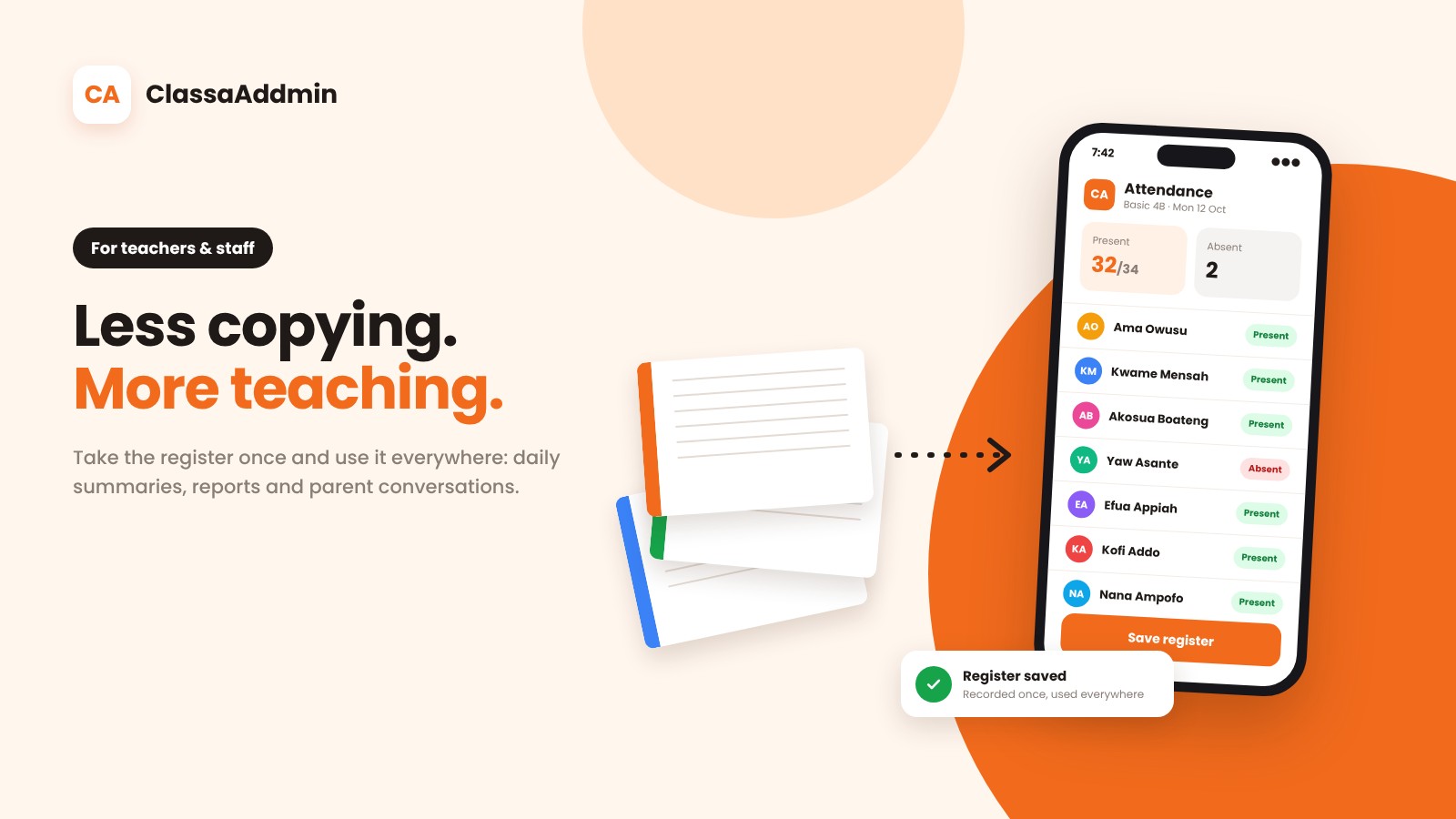
In many schools, attendance is taken in a class register, copied into a summary book for the office, and then entered again at the end of term for reports. Each copy is a chance for a mistake, and each takes time.
When attendance is recorded once, in a shared system, it can be used everywhere it is needed: daily summaries, termly reports and conversations with parents about a child who has missed school.
A student's details often live in several places: the admission form in a file, the class list in a teacher's notebook, emergency contacts in the office and medical notes somewhere else. When a parent's phone number changes, it is updated in one place and forgotten in the others.
Keeping one record per student, which every authorised staff member can see, means fewer "Who has the file?" moments. It also matters in an emergency, when the right phone number has to be found quickly.
Fee collection is one of the most time-consuming jobs in a private school. Payments arrive by cash, bank transfer and mobile money. Receipts are written by hand. Balances are worked out at the end of term, often under pressure.
Digital records make it easier to see who has paid, who owes what and when reminders are due [confirm whether ClassaAddmin handles fees]. Even where fees are handled elsewhere, having student records in one place makes reconciliation faster.
"Is there school on Friday?" "What time does the trip leave?" "Has the bus left yet?"
Each question takes only a minute, but a minute multiplied by dozens of parents becomes an hour. A large share of these calls come from two gaps: parents not receiving announcements reliably, and parents not knowing where the bus is.
ClassaAddmin closes the second gap directly. Parents follow the school bus in their own app, so the office no longer has to relay location updates by phone. Clear announcements to families help close the first [confirm].
Report season is when hidden hours become visible. Teachers gather scores, attendance and comments from different books and compile them, often late into the night.
When information is collected throughout the term in one place, end-of-term work becomes a matter of reviewing rather than rebuilding [confirm].
Moving to a digital system is not about replacing teachers' judgement. It is about removing the copying, searching and chasing that sits around it. Schools that make the switch usually notice three things:
Change in a busy school can feel like one more task on a full plate. A few habits make it easier:
Every hour saved on paperwork is an hour that can go back to lesson planning, marking or simply going home on time. ClassaAddmin is built to give teachers and staff those hours back, so they can focus on the work that brought them into education.
Want to see how ClassaAddmin could fit your school's routine? Talk to your head of school or book a walkthrough.
Keep reading
We'll set up your school, import your pupils and walk your team through it. No card, no commitment.